
Education and Training for Every Stage of Your Healthcare Career
Freeman Education Department offers a wide variety of continuing education programs for our staff, healthcare professionals and the community. We have been an American Heart Association (AHA) Training Center since 2004. Many of our life support courses are available to the community, whether you’re a lay person or an experienced healthcare professional.
Training areas include basic life support skills such as CPR and first aid, as well as initial and renewal courses for advanced cardiovascular life support (ACLS) and pediatric advanced life support (PALS). Our specialty courses designed for healthcare professionals range from basic certifications to advanced licenses in AWHONN, STABLE, NRP, ASLS and TNCC.
Freeman Clinical Courses
We offer a variety of life support programs from the American Heart Association (AHA) and the American Academy of Pediatrics and Emergency Nurses Association.
Which course is right for you?
HeartCode BLS uses a variety of eLearning assets such as dramatizations, eSimulations, animations, self-directed learning, and interactive activities to teach participants BLS knowledge and skills. HeartCode BLS is for healthcare professionals seeking an alternative method for completing an initial or renewal BLS Course.
Dates: This course is offered on a weekly basis.
Becoming an American Heart Association instructor is easy after consulting with an American Heart Association Training Center to find out whether the Training Center (TC) is accepting new instructors and the TCC’s (Training Center Coordinator) preferred course delivery. The steps are simple – get started today!
- Be accepted by your local AHA Training Center before enrolling in an Instructor Course and have a completed Instructor Candidate Application on file with that Training Center.
- Have current AHA provider status in the discipline for that Instructor Course and be proficient in all the skills of that discipline. Disciplines include ACLS, BLS, PALS, PEARS and Heartsaver®.
- Successfully complete the discipline-specific classroom Instructor Course.
- Successfully be monitored teaching your first course within six months of completing the discipline-specific classroom Instructor Course. Training Center Coordinators can require additional monitoring.
Prerequisite: Current BLS Provider Certification Instructional Method: Seated
Dates: This course is offered on a semi-annual basis.
BLS Instructors must attend updates as required within the previous 2 years of their cards expiration date. Updates may address new course content or methodology and review Training Center, regional and national ECC information.
Prerequisite: BLS Instructor Card Instructional Method: Blended
Dates: This course is offered on a semi-annual.
HeartCode® ACLS is a self-directed, comprehensive eLearning program that uses eSimulation technology to allow participants to assess and treat patients in virtual healthcare settings. Participants will be presented with a team dynamics lesson and 10 in-hospital patient cases, including a BLS case and 2 megacode cases. The cases may be repeated as many times as necessary to pass. Upon successful completion of all the patient cases, participants will take a multiple-choice exam and must pass with a minimum score of 84%.
Course Schedule: This course is offered on a weekly basis.
AHA’s ACLS Course has been updated to reflect new science in the 2015 AHA Guidelines Update for CPR and Emergency Cardiovascular Care. This course builds on the foundation of lifesaving BLS skills, emphasizing the importance of continuous, high-quality CPR. This advanced course highlights the importance of high-performance team dynamics and communication, systems of care, recognition and intervention of cardiopulmonary arrest, immediate post-cardiac arrest, acute dysrhythmia, stroke, and acute coronary syndromes (ACS).
Course Schedule: This course is offered on a monthly basis.
AHA’s ACLS Course has been updated to reflect new science in the 2015 AHA Guidelines Update for CPR and Emergency Cardiovascular Care. This course builds on the foundation of lifesaving BLS skills, emphasizing the importance of continuous, high-quality CPR. This advanced course highlights the importance of high-performance team dynamics and communication, systems of care, recognition and intervention of cardiopulmonary arrest, immediate post-cardiac arrest, acute dysrhythmia, stroke, and acute coronary syndromes (ACS). Course uses learning stations for practice of essential skills simulated clinical scenarios that encourage active participation-Hands-on class format reinforces skills proficiency -Classroom-based works well for learners who prefer group interaction and instructor feedback while learning skills
Course Schedule: This course is offered on a monthly basis.
The American Heart Association Family and Friends course teaches the lifesaving skills of adult hands-on CPR, adult CPR with breaths, child CPR with breaths, adult and child AED use, infant CPR, and mild and severe airway blocks for adults, children and infants. Skills are taught in a dynamic group environment using the AHA’s research-proven practice-while-watching technique, which provides participants with the most hands-on CPR practice time possible.
The AHA’s PALS Course has been updated to reflect new science in the 2015 AHA Guidelines Update for CPR and ECC. This classroom, instructor-led course uses a series of videos and simulated pediatric emergencies to reinforce the important concepts of a systematic approach to pediatric assessment, basic life support, PALS treatment algorithms, effective resuscitation and team dynamics. The goal of the PALS Course is to improve the quality of care provided to seriously ill or injured children, resulting in improved outcomes.
Features
- Classroom-based courses work well for participants who prefer group interaction and instructor feedback while learning
- Course includes realistic, clinical scenarios that encourage active participation – delivered through actual pediatric patient videos and lifelike simulations
- Course is comprehensive and includes our systematic approach to assess and treat pediatric patients in emergency situations
- Course uses a hands-on class format to reinforce skills proficiency
- Co-branded with the American Academy of Pediatrics (AAP)
Course Schedule: This course is offered on a monthly basis.
This American Heart Association workshop is designed to improve the quality of care provided to seriously ill or injured children, resulting in improved outcomes. This program is designed for physicians, nurses, paramedics, and respiratory therapists, who either direct or participate in resuscitation of a infant or child, whether in or out of the hospital. The update course is for those who have had PALS within the last 2 years.
Course Schedule: This course is offered on a monthly basis.
The PALS Instructor Course is designed to prepare instructor candidates to teach AHA instructor-led and blended learning courses. The course educates instructor candidates on how to adequately use AHA instructor teaching materials, ensure that participants meet learning objectives, offer participant coaching skills, provide an objective skills performance evaluation, and follow AHA instructor and course policies. The course covers core content and discipline-specific content required to teach AHA courses. Candidates who successfully complete the PALS Instructor Course, followed by course monitoring, will receive a PALS Instructor card, valid for two years. PALS instructors are then able to teach PALS Provider and HeartCode PALS Hands-on Sessions, as well as the PEARS Instructor-led Course.
Course Schedule: This course is offered on a semi-annual basis.
The PALS Instructor Course is designed to prepare instructor candidates to teach AHA Instructor-led and blended learning courses. The course educates instructor candidates on how to adequately use AHA instructor teaching materials, ensure that participants meet learning objectives, offer participant coaching skills, provide an objective skills performance evaluation, and follow AHA instructor and course policies. The course covers core content and discipline-specific content required to teach AHA courses. Candidates who successfully complete the PALS Instructor Course, followed by course monitoring, will receive a PALS Instructor card, valid for two years. PALS instructors are then able to teach PALS Provider and HeartCode PALS Hands-on Sessions, as well as the PEARS Instructor-led Course.
Course Schedule: This course is offered on a semi-annual basis.
The Neonatal Resuscitation Program® (NRP®) course conveys an evidence-based approach to care of the newborn at birth and facilitates effective team-based care for healthcare professionals who care for newborns at the time of delivery. NRP utilizes a blended learning approach, which includes online testing, online case-based simulations, and hands-on case-based simulation/debriefing that focus on critical leadership, communication, and team-work skills.
Course Schedule: This course is offered on a monthly basis.
The ASLS course addresses the pre-hospital, emergency department and stroke unit management of patients with acute stroke. Using interactive discussions, hands-on workshops, multimedia (video case-based scenarios) and standardized patient simulations (for stroke syndrome identification and management decision making), the course includes a discussion of the differential diagnosis of stroke, rapid recognition of five major stroke syndromes, training in the use of the Miami Emergency Neurologic Deficit (M.E.N.D.) exam (based on the National Institutes of Health Stroke Scale and incorporating the Cincinnati Pre-hospital Stroke Scale), education regarding the use of thrombolytic therapy in acute ischemic stroke patients, and a detailed discussion of the acute care of stroke patients in the hospital, including prevention of medical complications, rehabilitation in the acute setting, the diagnostic evaluation, secondary stroke prevention strategies and discharge planning for the patient and family. This course is appropriate for both new and experienced providers, particularly nurses and physicians who work in the emergency departments, stroke unit and stroke unit equivalents.
This comprehensive 2-day instructor-led course is critical for enhancing and validating nurses and physicians’ ability to interpret and respond to fetal heart monitoring tracings. Skills taught and knowledge assessed include maternal and fetal physiology, interpretation of fetal and uterine monitor tracings, evaluation of auscultated fetal heart sounds, Leopold’s Maneuvers, placement of fetal spiral electrodes and intrauterine pressure catheters, and evaluation of and strategies for enhancing communication. The course is presented to approximately 15,000 clinicians a year and may be used as a competency assessment to validate the knowledge and skills of perinatal clinicians who utilize fetal monitoring and includes a post-test to assess participant knowledge.
Course Schedule: This course is offered on a quarterly basis.
This 2-day course sponsored by the Emergency Nurses Association is the premier course for hospitals and trauma centers worldwide, empowers nurses with the knowledge, critical thinking skills and hands-on training to provide expert care for trauma patients. At successful completion of the course, participants will be able to perform rapid identification of life-threatening injuries, comprehensive patient assessment and enhanced intervention for better patient outcomes.
The S.T.A.B.L.E. course is based on a mnemonic to optimize learning, retention and recall of information. S.T.A.B.L.E. stands for the six assessment and care modules in the program: sugar, temperature, airway, blood pressure, lab work and emotional support. A seventh module – quality improvement – stresses the professional responsibility of improving and evaluating care provided to sick infants.
Through our STOP THE BLEED® course, you’ll gain the ability to recognize life-threatening bleeding and intervene effectively. The person next to a bleeding victim may be the one who’s most likely to save them. The course allows participants to become empowered to make a life-or-death difference when a bleeding emergency occurs. STOP THE BLEED. Save a Life!
Earn While You Learn
The Freeman Health System UAP program is a 90-day paid program that enables nurse technicians to receive additional training all while being a Freeman employee.
- No Missouri CNA required
- Participants can have a CNA from another state or no patient care experience at all. Applicants with another state’s CNA have the opportunity to test out of the UAP program.
- Once completed, participants are eligible to sit for the Missouri CNA exam.
- Training is completed in Freeman’s simulation lab and on-the-job training in the department.
- Program provides opportunities for advancement and valuable experience.
- A total of 175 hours of both classroom instruction and clinical practicum must be completed within 90 days from the start or transfer date of the employee.
- Freeman employees must be in their current position for 1 year prior to transfer.
- Applicants must be 18 years old prior to beginning employment.
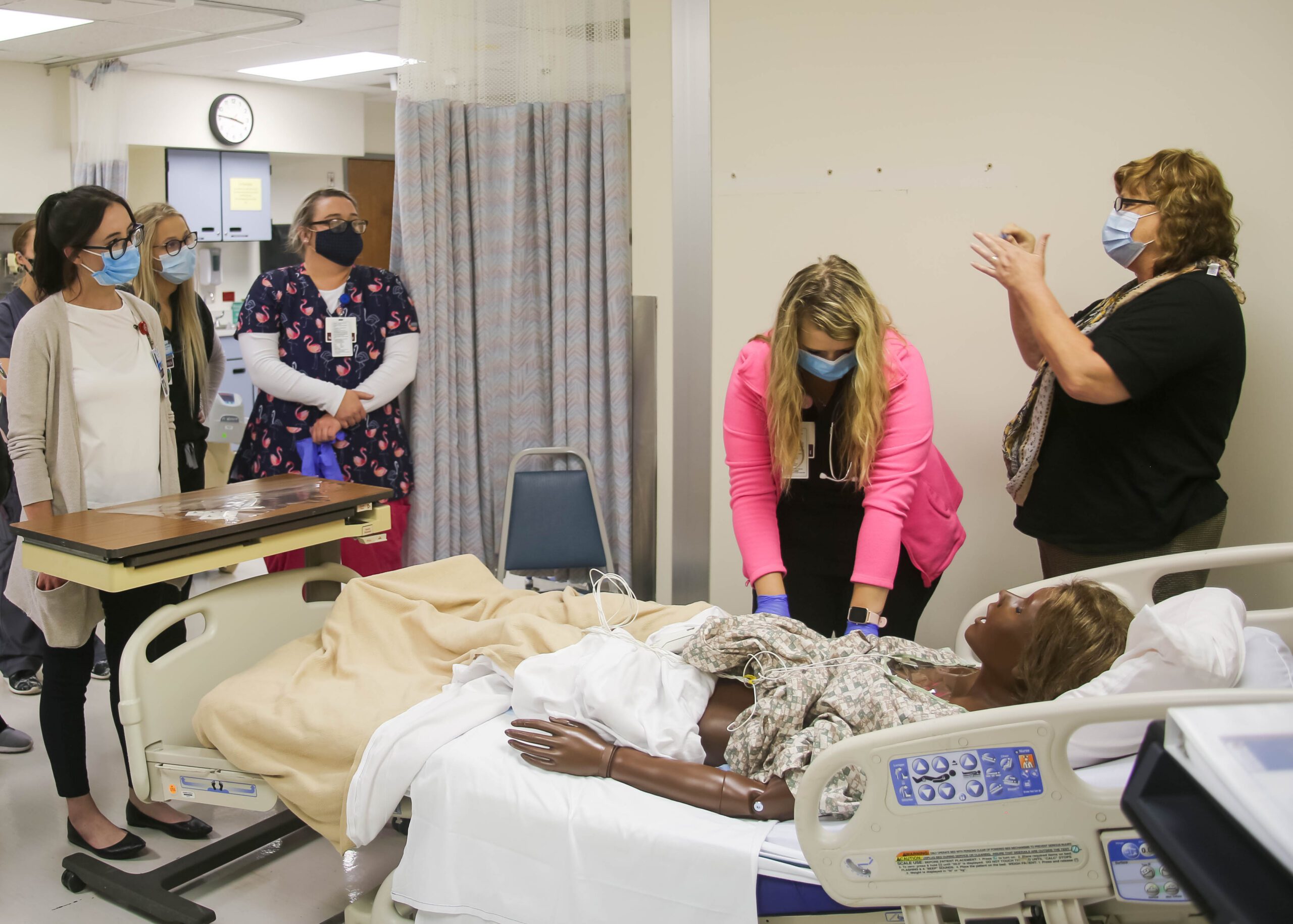
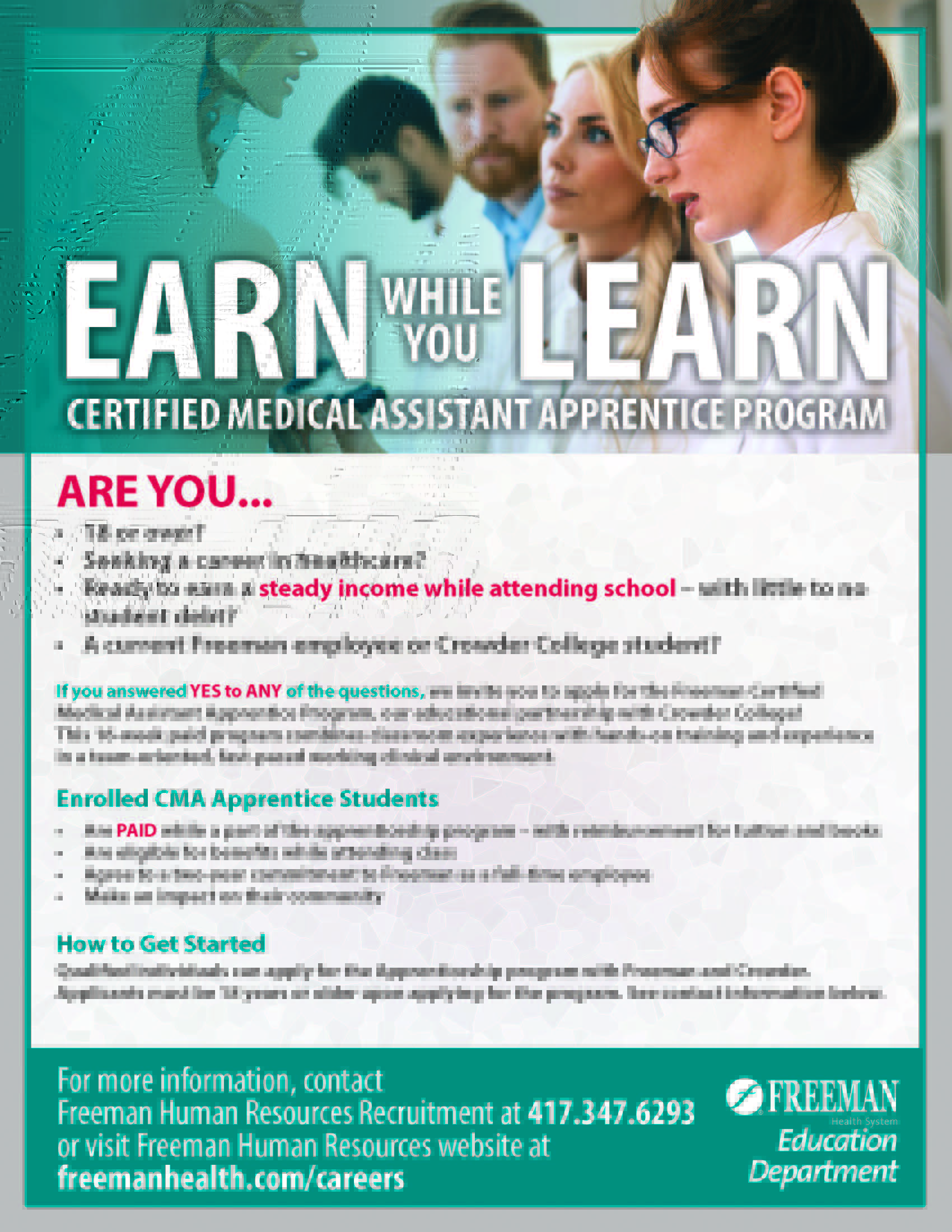
The Certified Medical Assistant Apprenticeship is a 16-week paid program in partnership with Crowder College.
- The program combines Crowder College classroom education and on-the-job training with tuition paid.
- Students will be Freeman employees and will earn income and be benefit eligible while attending classes.
- Students spend 20 hours a week benefitting from a variety of learning opportunities, including traveling to various clinics within the area.
- At the completion of the program, students will sit for the Certified Medical Assistant National Exam.
- Students will be required to commit to two (2) years of full-time employment with Freeman.
- Applicants must be 18 years old prior to beginning employment.
- The first application cycle opens in November with the program beginning in January. The second application cycle opens at the end of June with the program beginning in August. *Application cycles may vary based on orientation dates and Crowder semester schedules.
- Please contact Freeman Human Resources Recruitment at 417-347-6293 for more information.
Freeman Student Rotations
As a teaching hospital, Freeman is proud to provide opportunities for advanced practitioner students to complete their clinical rotations with Freeman advanced practitioners and physicians. We will do our best to match you in your requested area/specialty, but there may be times when we will be unable to accommodate requests. All clinical rotations are unpaid. Freeman does not charge a fee for advanced practitioner students to complete clinical rotations. There may be fees incurred to meet the pre-qualification requirements for being a student at Freeman, such as background check fees.
- An affiliation agreement between Freeman and the school must be established. Freeman will review if there is an active agreement on file once the completed application is received.
- All requirements within the affiliation agreement must be met prior to the student being scheduled for their HR appointment.
- Clinical rotation applications and supporting documentation must be submitted a minimum of 45 days in advance of the rotation start date.
- Students are not guaranteed a clinical rotation. Freeman reserves the right to deny a request for rotation.
- Students found to be completing a clinical rotation without going through the appropriate process risk having their student privileges immediately revoked.
As a teaching hospital, Freeman is proud to provide opportunities for students seeking clinical or non-clinical internships. We will do our best to match you in your requested area/specialty, but there may be times that we will be unable to accommodate requests. All clinical and non-clinical internships are unpaid. Freeman does not charge a fee for students completing their internships. There may be fees incurred to meet the pre-qualification requirements for being a student at Freeman, such as background check fees.
- An affiliation agreement between Freeman and the school must be established. Freeman will review if there is an active agreement on file once the completed application is received.
- All requirements within the affiliation agreement must be met prior to the student being scheduled for their HR appointment.
- Clinical or non-clinical internship applications and supporting documentation must be submitted a minimum of 45 days in advance of the rotation start date.
- Clinical or non-clinical internship must be required as part of the student’s declared degree or program as a condition for graduation.
- Students are not guaranteed an internship. Freeman reserves the right to deny a request for rotation.
- Students found to be completing an internship without going through the appropriate process risk having their student privileges immediately revoked.
Clinical Internship
Non-Clinical Internship
The Certified Medical Assistant Apprenticeship is a 16-week paid program in partnership with Crowder College.
- The program combines Crowder College classroom education and on-the-job training with tuition paid.
- Students will be Freeman employees and will earn income and be benefit eligible while attending classes.
- Students spend 20 hours a week benefitting from a variety of learning opportunities, including traveling to various clinics within the area.
- At the completion of the program, students will sit for the Certified Medical Assistant National Exam.
- Students will be required to commit to two (2) years of full-time employment with Freeman.
- Applicants must be 18 years old prior to beginning employment.
- The first application cycle opens in November with the program beginning in January. The second application cycle opens at the end of June with the program beginning in August. *Application cycles may vary based on orientation dates and Crowder semester schedules.
- Please contact Freeman Human Resources Recruitment at 417-347-6293 for more information.
Education Department
Freeman Job Shadowing
The Freeman job shadowing program enables students and community members to explore healthcare careers by shadowing caregivers. Through the program, members of our medical team share experience, advice and knowledge with participants. Students are encouraged to use their firsthand experiences at Freeman help make decisions about class choices, continuing education and their career.
Participating departments include:
- Anesthesiology
- Cancer (Oncology)
- Cardiology
- Cardiovascular Operating Room
- Cath Lab
- Emergency Department
- General Medical
- Infusion Center
- Laboratory
- Occupational Therapy
- Operating Room/Scrub Technicians
- Orthopedics
- Pharmacy
- Physical Therapy
- Physician Assistants
- QuickMeds Pharmacy™
- Radiology
- Respiratory Therapy
- Social Services
Guidelines
- Participants must be 16 or older. Some departments may require the participant to be 18 or older.
- We make every effort to arrange shadow opportunities in the student’s area(s) of interest.
- Job shadowing hours will be limited to two days or up to 16 hours in a calendar year (January 1 – December 31). Exceptions may be made based on the requirement of a degree or program. Supporting documentation will be required to shadow more than 16 hours.
- Job shadowing takes place during regular business hours, Monday through Friday, 7:30 am – 4:30 pm.
- Completion of registration form, confidentiality and non-disclosure agreement form, observational experience agreement form, observational expectations and regulations form, and HIPAA 101 patient privacy training are required for each shadow experience.
- Applications for those under the age of 18 require a parent/legal guardian’s signature on each of the forms.
- A copy of your valid photo ID.
Registration
- Applications must be completed entirely, prior to submission.
- Applications must be submitted to the Freeman Education Department to be considered for the job shadowing program.
- Please be aware that your job shadow experience will not be scheduled until all forms are completed and submitted.
- Please allow a minimum of two weeks between the date the completed application is returned to the Freeman Education Department and your desired shadowing date.
- Participants will be scheduled to complete additional paperwork and review HIPAA patient privacy training prior to the job shadow experience.
Contact Our Job Shadowing Team
Address
Education Department
1111 McIntosch Circle, Suite 313
Joplin, MO 64804
Education and Training for Every Stage of Your Healthcare Career
Freeman Education Department offers a wide variety of continuing education programs for our staff, healthcare professionals and the community. We have been an American Heart Association (AHA) Training Center since 2004. Many of our life support courses are available to the community, whether you’re a lay person or an experienced healthcare professional.
Training areas include basic life support skills such as CPR and first aid, as well as initial and renewal courses for advanced cardiovascular life support (ACLS) and pediatric advanced life support (PALS). Our specialty courses designed for healthcare professionals range from basic certifications to advanced licenses in AWHONN, STABLE, NRP, ASLS and TNCC.
Questions? Contact Us!
Education Department
1111 McIntosh Circle, Suite 313
Joplin, MO 64804
Phone: 417.347.5845
Fax: 417.347.2520
Email: [email protected]